
Serving Pompano Beach, Boynton Beach, and surrounding areas

To tell mice and rats apart, check body size, ear proportion, and tail features. Mice are small (2–4 inches) with large ears and long, thin tails. Rats are much larger (7–10+ inches) with thick bodies, small ears relative to their head size, and thick, blunt tails. Mice leave tiny, pointed droppings and nibble small holes, while rats leave large, capsule-shaped droppings and gouge through wood, plastic, or PEX piping.
Key Takeaways:
- Trapping strategies differ significantly—mice are naturally curious and explore new traps, whereas rats exhibit neophobia (fear of new objects) and actively avoid freshly set traps.
- Mouse colonies expand rapidly, producing dense scatters of tiny droppings throughout living spaces, while rat colonies are smaller and leave heavy grease marks along fixed pathways.
- Because rats possess far stronger jaws, they inflict rapid structural damage by chewing through plumbing lines, thick beams, and heavy building materials.
- Elevated noises in attics or soffits typically indicate Roof Rats, while low-level pantry or appliance activity usually points to House Mice.
Discovering signs of a rodent infestation—whether it’s droppings behind pantry supplies, faint wall rustling, or chewed wiring—triggers an immediate need for clarity. Because mice and rats exhibit fundamentally different behaviors, food preferences, and movement patterns, treating a rat problem with a mouse strategy almost guarantees failure. Accurate identification is your first and most critical line of defense.
In subtropical environments, understanding which species you might be up against comes down to regional prevalence and how local structures accommodate their habits.
Are Rats or Mice More Common in South Florida?
Both rats and mice are exceptionally common throughout South Florida homes and businesses. While house mice thrive in interior structures, South Florida’s warm climate and coastal architecture make Roof Rats the single most prevalent outdoor and attic pest in the region, outnumbering ground-nesting Norway Rats.
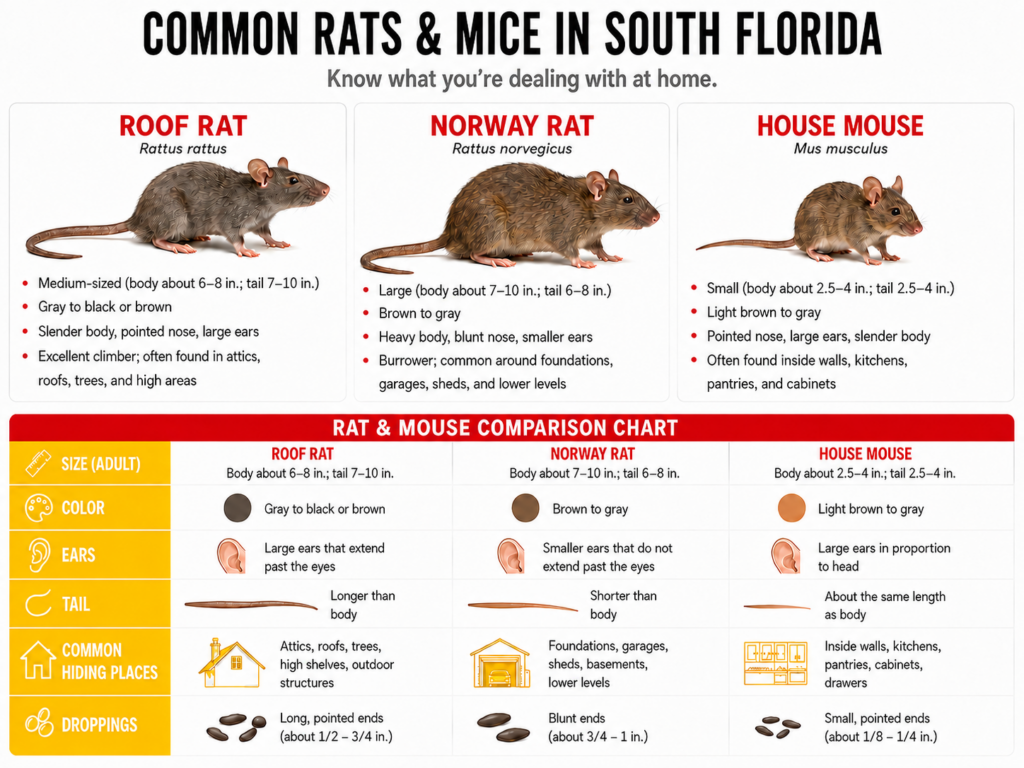
In our region, you are most likely to encounter three main species:
- House Mice: Small, inquisitive, and able to squeeze through openings as tiny as a dime, often accessing homes through unsealed utility penetrations or gaps along door sweeps.
- Roof Rats: Agile climbers that dominate South Florida neighborhoods. They utilize palm tree canopies, power lines, and overhanging vegetation to reach upper rooflines, nesting inside attics, soffit voids, and ceiling cavities.
- Norway Rats: Larger, heavier burrowers that typically stick to ground-level outdoor areas, burrowing along home foundations, beneath concrete slabs, air conditioner pad foundations, or inside crawl spaces.
Key Visual Differences – Rat vs. Mouse
To tell a rat from a mouse, look at body proportions rather than size alone. Mice have small bodies (2–4 inches) with disproportionately large ears and long, thin tails. Rats are significantly larger (7–10+ inches) with heavy bodies, smaller ears relative to their head size, and thick tails.
Physical Feature | Mouse (House Mouse) | Rat (Roof Rat / Norway Rat) |
Body Size | 2 to 4 inches long | 7 to 10+ inches long |
Weight | 0.5 to 1 ounce | 7 to 18 ounces |
Snout | Pointed | Blunt (Norway) or slightly pointed (Roof) |
Ears | Large relative to head, sparse hair | Small relative to head (Norway) or prominent (Roof) |
Tail | Long, thin, hairy | Short/thick (Norway) or longer than head+body (Roof) |
Signs of Infestation – Rats vs. Mice
To identify whether you have rats or mice, inspect gnaw marks, movement sounds, and wall rub marks. Mice leave tiny, clean nibble marks and faint scratching sounds inside lower cabinets. Rats leave large, rough gouges on wood or plastic, heavy scurrying in attics, and dark grease smudges along beams.
Both pests leave distinct clues behind, but closer inspection reveals key nuances between species:
- Gnaw Marks: Mice leave small, clean nibble marks about the size of a ballpoint pen tip. Rats have powerful jaws that leave larger, rough gouges on wood, plastic, PEX plumbing lines, and even soft metals.
- Noises: Mice inside walls usually sound like faint scratching or rustling. Rat movement is noticeably heavier, producing louder thuds, persistent scraping, and loud scurrying, especially in attics and above drywall ceilings at night.
- Rub Marks: As rodents travel along walls, oily grease from their fur leaves dark smudges. Because rats follow strict, habitual pathways along baseboards, structural roof trusses, and exposed pipe runs, their rub marks are significantly darker and thicker.
- Nesting Materials: Mice shred soft materials like paper, fiberglass insulation, and fabric into fluffy, ball-shaped nests inside quiet interior corners. Rats use coarser materials like twig fragments, heavy cardboard, palm frond fibers, and coarse leaves, often building larger nests in attics, soffit voids, or outdoor burrows.
Rat Poop or Mouse Poop – Which Is It?
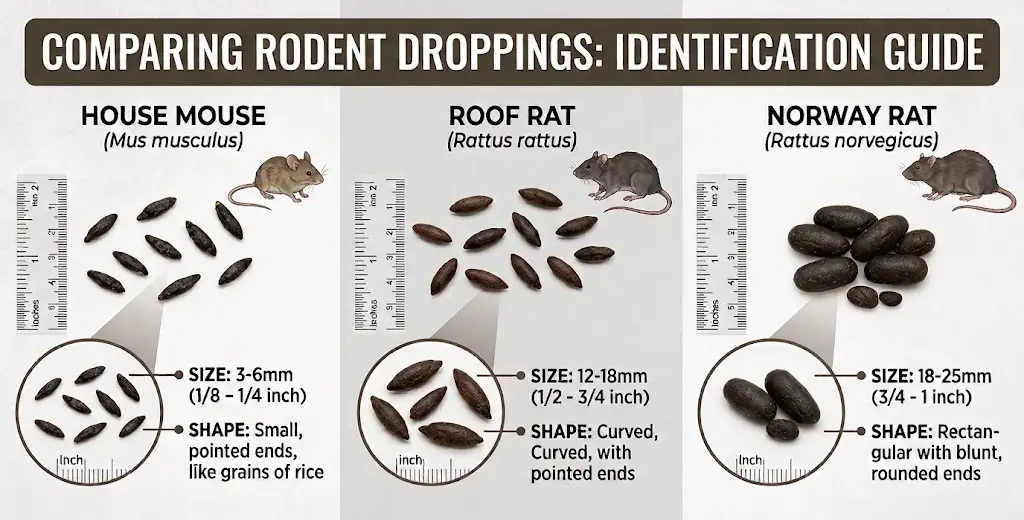
Tell rat poop from mouse poop by inspecting size, shape, and distribution. Mouse droppings are small (1/8 to 1/4 inch) with pointed ends, scattered widely near food. Rat droppings are larger (1/2 to 3/4 inch), capsule-shaped with blunt or pointed ends, and clustered along strict travel paths.
While individual rats and mice produce similar daily amounts of droppings on a single-rodent basis, mice reproduce far faster and live in significantly larger colonies. As a result, mouse infestations typically leave behind a much higher total volume of scattered droppings throughout a home compared to a rat infestation.
Feature | Mouse Droppings | Rat Droppings |
Size | 1/8 to 1/4 inch long (rice grain size) | 1/2 to 3/4 inch long |
Shape | Small, thin, with pointed ends | Capsule-shaped with blunt or pointed ends |
Individual Output | 40–100 per day (per mouse) | 40–50 per day (per rat) |
Infestation Volume | Extremely High: Higher population densities lead to widespread, dense scattering. | Moderate to Low: Smaller colony sizes mean fewer total droppings spread across space. |
Location | Scattered near food sources, drawers, and counter edges | Concentrated along strict run paths, baseboards, or near nesting zones |
Where Do Rats and Mice Like to Nest?
Rats and mice nest in distinct locations based on each species’ climbing ability. House mice nest in low-level interior spots like kitchen cabinet voids and appliance bases. Roof rats exploit South Florida architecture, entering via barrel tile roof gaps, open soffit vents, and AC line chase penetrations to nest in attics.
Understanding where each rodent prefers to live helps narrow down which pest has invaded your home:
- House Mice: Prefer warm, hidden spots close to indoor food sources. You will frequently find mouse nests behind kitchen appliances, inside wall voids near pantries, under low cabinets, or around hot water heater closets.
- Roof Rats: True to their name, these rats prefer elevated structures. In South Florida homes, they enter through unsealed barrel tile roof caps, gaps in soffit vents, and open AC line chase penetrations, nesting in upper attic insulation, ceiling voids, and dense outdoor foliage like cabbage palms or overgrown bougainvillea.
- Norway Rats: Prefer ground-level or subterranean living. They construct deep burrow systems along home foundations, beneath concrete patio slabs, air conditioner pad bases, or inside ground-floor crawl spaces and shed bases.
Rodent Risk Factors
Having any rodent in your home presents serious risks to both health and property:
- Property Damage: Both pests chew constantly to file down their teeth. However, rats can gnaw through tough materials like PEX plumbing pipes and heavy wood. Rats and mice will also sometimes chew through electrical wires.
- Contamination & Disease: Rodents contaminate food prep areas, utensils, and pantry goods with urine, dander, and feces. They are known vectors for diseases such as Leptospirosis, Hantavirus, and Salmonella.
- Parasites: Rats and mice frequently carry secondary pests into living spaces, including fleas, ticks, and mites, creating additional infestation issues for pets and family members.
Are Rats or Mice More Dangerous to Have in Your House?
While neither guest is welcome, rats generally pose a greater immediate threat to your physical structure and health. Their sheer physical size and stronger jaws allow them to inflict severe structural damage far faster than mice, including severe plumbing leaks and structural wood damage. Furthermore, rats carry a higher pathogen load and tend to display greater aggression when cornered.
That said, mice reproduce at an astonishing rate—a minor mouse issue can quickly spiral into a massive infestation in just a few months. Neither species should ever be ignored.
When Should You Call a Rodent Exterminator?
The ideal time to call an exterminator is the moment you notice a single sign of activity. Standard DIY traps often fail because rats are naturally cautious of new objects, while mice reproduce faster than basic traps can keep up.
A professional inspection provides a comprehensive solution:
- Locates Hidden Nesting Areas: Uncovering hidden breeding grounds in attics, crawl spaces, and wall voids.
- Identifies Entry Points: Pinpointing every gap, crack, or roof line opening where pests gain access.
- Targeted Extermination: Tailoring exact control methods based on whether you are dealing with mice or rats.
- Exclusion & Prevention: Sealing structural vulnerabilities to prevent future invasions permanently.